
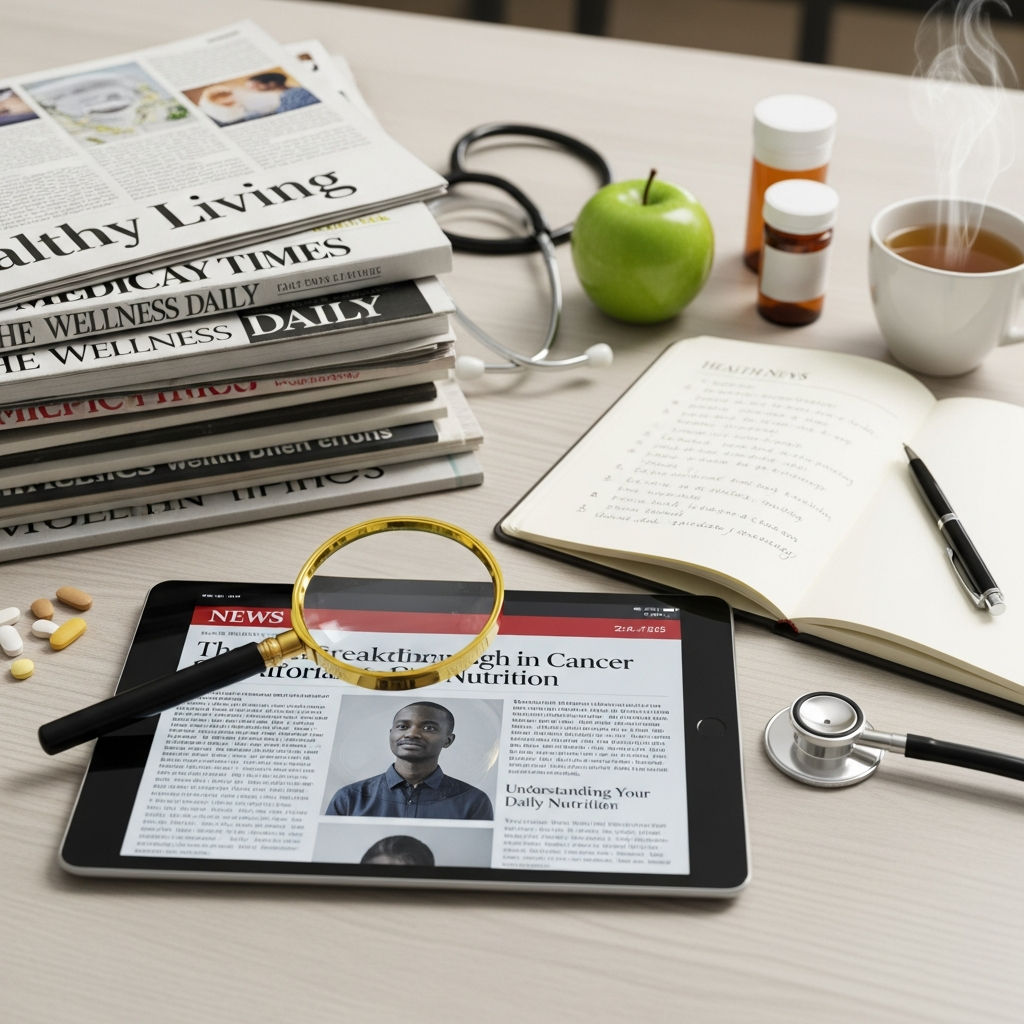
The Effective Guide to Health News for Beginners
In an era where information is available at the click of a button, staying informed about your health has never been easier—or more confusing. One day, a headline claims that coffee is the secret to longevity; the next, a study suggests it might increase your risk of heart disease. For beginners, navigating the world of health news can feel like walking through a minefield of contradictions and jargon.
Developing health literacy is essential for making informed decisions about your diet, lifestyle, and medical care. This guide is designed to help you decode health news, identify credible sources, and understand the difference between a breakthrough and a “clickbait” headline.
Why Following Health News Matters (and Why It’s Confusing)
Health news serves as a bridge between complex scientific research and the general public. When reported accurately, it empowers you to take proactive steps toward wellness. However, the media often prioritizes “sharability” over scientific nuance. To a beginner, a preliminary study on mice might be presented as a “miracle cure” for humans, leading to false hope or unnecessary lifestyle changes.
Understanding health news isn’t just about reading; it’s about critical thinking. It requires you to look beyond the flashy title and examine the substance of the report. By the end of this guide, you will have the tools to separate scientific fact from marketing fiction.
Distinguishing Between Credible and Unreliable Sources
Not all health information is created equal. The source of the news is the first and most important filter you should apply. Generally, health information comes from three primary tiers:
1. Peer-Reviewed Medical Journals
These are the “gold standard” of scientific information. Before a study is published in journals like The Lancet, The Journal of the American Medical Association (JAMA), or The New England Journal of Medicine, it undergoes rigorous scrutiny by other experts in the field. If a news article doesn’t link to or mention a peer-reviewed study, proceed with caution.
2. Government and Educational Institutions
Websites ending in .gov or .edu (such as the CDC, NIH, or Mayo Clinic) are generally reliable. These organizations have teams of experts who synthesize complex research into actionable advice for the public. They are less likely to be driven by the need for clicks or the desire to sell a specific supplement.
3. Mainstream Media and Health Blogs
This is where most beginners get their news. While many journalists do an excellent job, some outlets may oversimplify findings to make them more “exciting.” Always use these articles as a starting point, not the final word. Always look for a link to the original research.
Understanding Scientific Terminology: A Beginner’s Lexicon
To read health news effectively, you need to understand a few key terms that researchers use. Misinterpreting these words is the most common cause of health-related confusion.
Correlation vs. Causation
This is the most important distinction in health science. Correlation means two things happen at the same time. Causation means one thing actually caused the other. For example, a study might find that people who eat blueberries live longer. That is a correlation. It doesn’t necessarily mean blueberries cause longer life; it might just be that people who eat blueberries also tend to exercise more and smoke less.

Sample Sizes and Demographics
Always look at who was studied. A study of 10 people is much less reliable than a study of 10,000. Similarly, a study conducted entirely on laboratory rats may not apply to humans. If a headline screams about a “breakthrough” but the study only involved a small group of specific individuals, the results are preliminary, not definitive.
Double-Blind and Placebo-Controlled
The most reliable studies are “double-blind.” This means neither the participants nor the researchers know who is getting the actual treatment and who is getting a “placebo” (a sugar pill). This prevents bias from influencing the results.
The Hierarchy of Scientific Evidence
When you encounter health news, it’s helpful to know where the underlying study sits on the “ladder” of evidence. Not all studies carry the same weight:
- Systematic Reviews and Meta-Analyses: These are the most powerful. They look at dozens of different studies on the same topic to find a consistent trend.
- Randomized Controlled Trials (RCTs): These are high-quality studies where participants are randomly assigned to groups to test a specific intervention.
- Observational Studies: These track people over time. They are great for finding correlations but cannot prove causation.
- Animal Studies and In-Vitro (Cell) Research: These are “early stage” research. They are fascinating but often fail to translate into human results.
Spotting Red Flags in Health Reporting
How can you tell if a health article is more interested in your clicks than your well-being? Look for these common red flags:
- The “Miracle” Claim: Science moves slowly. Any article claiming a “miracle cure,” “secret trick,” or “overnight fix” is likely exaggerated.
- Sensationalized Headlines: If the headline uses “Everything you know is wrong” or “Doctors hate this one trick,” it’s clickbait.
- Single-Study Reliance: Science is a cumulative process. One study rarely changes the entire medical consensus. Be wary of news that ignores years of previous research.
- Hidden Agendas: Check who funded the study. If a study claiming chocolate is a health food was funded by a chocolate company, you should view the results with a healthy dose of skepticism.
- Anecdotal Evidence: A story about one person’s “miraculous recovery” is an anecdote, not scientific proof. Individual stories are powerful, but they don’t replace clinical data.
Practical Steps to Fact-Check Health News
If you see a health headline that catches your eye, follow these simple steps to verify its accuracy before you change your habits:
- Read past the headline: The headline is written by an editor to grab attention; the actual article often contains more nuance.
- Identify the original source: Look for the name of the journal or the university where the research was conducted.
- Check the date: Medical science evolves rapidly. An article from 2010 might be completely outdated by 2024.
- Look for “Conflict of Interest” statements: Reputable journals require authors to disclose who paid for the research.
- Consult a professional: Before starting a new supplement or diet based on a news report, talk to your doctor or a registered dietitian. They can help you understand how that news applies to your specific health profile.
The Role of Social Media in Health News
Social media platforms like TikTok and Instagram are now major sources of health information. While some experts use these platforms to educate, they are also breeding grounds for “wellness influencers” who lack medical credentials.
When consuming health news on social media, remember that “engagement” (likes and shares) does not equal “accuracy.” An influencer’s personal experience is not a substitute for clinical research. Always verify social media claims against reputable sources like the WHO or established medical institutions.
Conclusion
Becoming a savvy consumer of health news is a journey, not an overnight process. The goal isn’t to become a scientist, but to develop a “skeptical curiosity.” By focusing on credible sources, understanding basic scientific terms, and looking for red flags, you can protect yourself from misinformation.
In the world of health, the truth is often less dramatic than the headlines suggest. It usually involves a balance of nutrition, exercise, sleep, and evidence-based medical care. Use health news as a tool to stay curious, but always let science—and your healthcare provider—be your ultimate guide.